The Client Has AI. So Why Hire a Designer?
AI puts design tools in every client’s hands. That changes what our profession must prove: not just creativity, but judgment, coordination and work worth paying for.

A client can now arrive at a design meeting with a folder of AI-generated interiors, a proposed floor plan and a convincing image of a house that does not exist. Some will look at those results and ask a reasonable question: Why pay a designer if I can get this far myself?
Our industry cannot answer that question by becoming defensive. The tools are useful. They are becoming more capable. And yes, some clients will use them instead of hiring someone for work they previously paid for.
But that makes it more important to distinguish the work that creates an idea from the work that turns it into a place people can actually use. At Tristan Scott Design, we believe the future belongs to studios that make that difference visible—and deliver it efficiently enough that good design remains accessible.
The Architects We Study Were Solving Different Problems
Design school introduces us to Louis Sullivan, Frank Lloyd Wright and Frank Gehry through memorable buildings, drawings and ideas. It can make architecture look like a sequence of extraordinary people producing extraordinary forms. The work behind those forms is less easy to put on a lecture slide.
Sullivan was working in the context of Chicago's rebuilding, commercial growth and the possibilities of steel-frame construction. His questions included how a tall commercial building should express a new structural and urban reality. That was a technological transition too—not an era when design existed outside economics or construction. The Chicago Architecture Center's account of Sullivan places his work in that context.
Wright's Fallingwater involved a specific landscape, local sandstone, reinforced concrete and a client whose expectations of the site differed from the architect's response. Its later cantilever strengthening is a reminder that even an architectural landmark has a technical life beyond the celebrated image. The Fallingwater organization documents the original design and its subsequent preservation work. Admiring the ambition does not mean pretending the engineering and maintenance challenges disappeared.
Gehry belongs to a different chapter again. By the development of Guggenheim Bilbao in the 1990s, his practice was combining physical models with CATIA digital modelling to translate complex shapes into buildable information. The Guggenheim's account of that analog-and-digital process makes it clear: we should not group Gehry, Wright and Sullivan into one supposedly pre-digital age.
The useful lesson is not that those architects had it easier, or that today's software makes us their equals. It is that design has always changed when the available tools and the surrounding world changed. The lasting work was not simply knowing how to use the tool. It was deciding what to make, why it mattered and how to carry it into reality.
Today, the Client Has the Tools Too
Clients have always brought references and opinions. AI changes how far they can develop those ideas before involving a professional. Someone who could not draw a room can generate alternatives. Someone unsure how to describe their taste can compare visual directions. Someone considering a renovation can start asking better questions about layout.
That is not a threat we need to dismiss. It is useful participation. A client who can show us what they mean may help us reach a better direction sooner.
It would also be dishonest to claim AI only makes pictures. Products such as Autodesk Forma Site Design already support site planning, massing and environmental analysis. Those capabilities are different from asking a general chatbot for a house plan, but they show why the profession cannot treat AI as a passing rendering trend.
For a low-risk decorating decision, a capable client may not need a full design team at all. Choosing an aesthetic direction or testing a furniture idea is not the same engagement as reconfiguring a house, coordinating its structure and systems, or developing a complete interior and exterior package. Professional fees should reflect the work actually needed—not the assumption that the client is incapable of doing anything themselves.
More Options Do Not Automatically Mean Better Decisions
Today's designers operate in a different information environment. We can explore more options, but clients can also receive contradictory answers from image generators, social media, manufacturers, contractors and search results. Part of the job is deciding which information is reliable and which recommendation fits this particular project.
At the same time, the design still has to address budget, material availability, energy use, permitting and the way the work will be built. Those concerns did not appear with AI. What changes is the expectation that a convincing answer should be available immediately, because a convincing image often is.
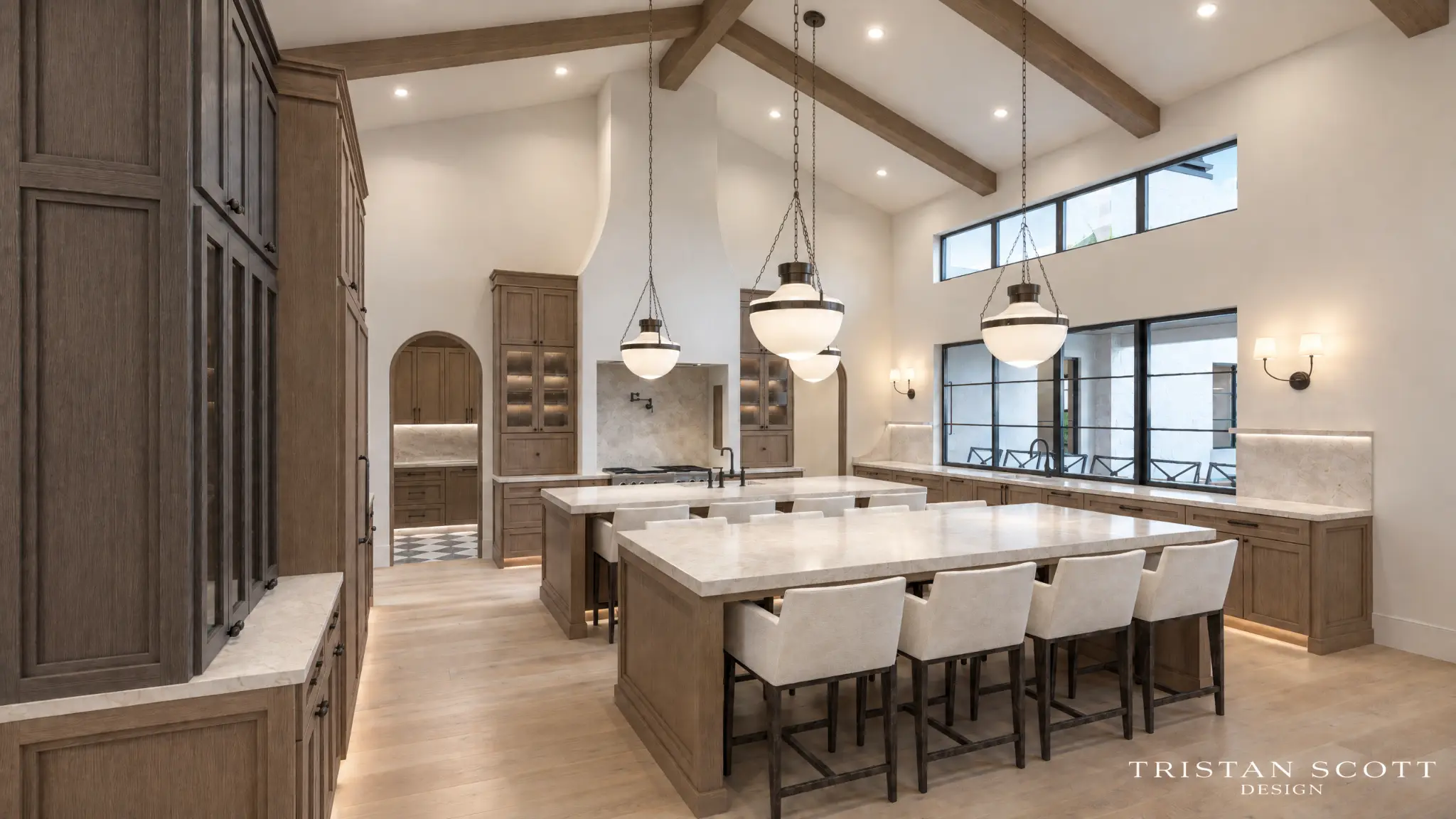
An Arizona home is a practical example. A dramatic glazed wall has an orientation, a shading strategy and a relationship to indoor comfort. A larger room changes what happens to adjacent rooms. A higher ceiling affects more than the appearance of a rendering. A beautiful kitchen still needs appliance clearances, working circulation and cabinetry details that agree with the rest of the plan.
The risk is not that every AI suggestion is wrong. It is that a suggestion can look resolved before anyone has checked the information it depends on. A professional can make that mistake too. The standard should be verification, not blind trust in either a human title or a software output.
What a Client Is Actually Paying Us to Do
At TSD, the floor plans and renderings are extensions of our full-design service—not a substitute for being the designer. They help clients see decisions clearly while we work through the relationships between the architecture, interiors and the way the project will be delivered.
On Williams Circle Residence, that work started with measuring and drafting the existing floor plan on site, then developing options before the investors closed. The subsequent interior and exterior work belongs to the same transformation. The value is not just a collection of attractive images; it is a coherent direction grounded in the existing property and coordinated with the next stages.
Corrine Residence illustrates a different kind of judgment. We studied whether the angled existing structure could support the intended expansion before developing a ground-up concept. That is a decision about a real lot, setbacks and the client's objectives. It is not resolved by generating a more impressive facade. The project remains in development; a concept rendering is not a claim that every permit or technical decision is complete.
A good designer also helps a client decide what not to do. An impressive feature may consume money that would improve the plan elsewhere. A repeated detail may create unnecessary fabrication complexity. A finish may photograph beautifully but be a poor fit for the people using the space. Saying no, explaining why and proposing a better alternative is part of the service.
Your budget should buy useful decisions and a coordinated design—not an award collection or the prestige of a name. Technology should help us remove avoidable repetition, explain options more clearly and direct more effort toward the parts of the project that actually need judgment. It should not become another excuse to charge for mystery.
Accountability Does Not Come With the Prompt
There is a difference between software helping prepare work and software taking responsibility for it. NCARB's position, updated in April 2026, keeps professional judgment and responsible control with the practitioner; AI does not become the licensed person who seals a technical submission.
That does not mean every decorating project, home or interior scope requires an architect. Requirements vary with the project and jurisdiction. Where licensed architectural or engineering services are required, the appropriate professionals still need to be involved. Buying a design service is not the same thing as buying a stamp, and a designer should be clear about the scope and specialist coordination they provide.
Accountability is also practical. Who verifies the dimensions? Who reconciles changes across the drawings? Who explains an unresolved detail to the builder? Who tells the client an appealing option does not fit the agreed budget? The right team should be able to answer those questions without pretending any process can eliminate every error.
Will AI Replace Architects and Designers?
It can replace some tasks, reduce demand for some standalone services and change what clients will pay for. That is different from proving it will replace an entire profession.
We should not give students or clients the comforting but unsupported promise that nothing will change. We should also not declare that all professional design work will disappear on a specific timeline. More capable tools, different business models and changing rules could alter the division of work further. Nobody can responsibly give a certain date for complete replacement.
The RIBA Artificial Intelligence Report 2026 describes both emerging productivity benefits and concerns about jobs, intellectual property, environmental impacts and early-career learning. The AIA AI Task Force's 2026 guidance likewise discusses opportunities to reduce routine work while emphasizing coordination, context and professional accountability. These are informed perspectives on a changing profession—not proof that its future is guaranteed.
The pressure will be real for businesses whose value consists mainly of producing an output a client can now generate themselves. Studios that use new tools well may be able to offer more useful service with less friction. But adoption alone will not make a weak designer strong. A faster workflow still needs someone capable of testing its assumptions and making decisions in the client's interest.
For younger designers, there is another challenge. If routine drafting and documentation tasks become more automated, firms cannot simply remove that work and assume people will learn coordination by watching a screen. They will need deliberate mentoring, field exposure and opportunities to understand why a detail succeeds or fails. Future competence has to be developed, not downloaded.
A Better Future Should Be Better for the Client
Our answer is not to keep clients away from AI. Bring the images. Bring the layout idea. Tell us what you love and what you are trying to achieve. We can examine those ideas together, identify what is worth keeping and develop them into a design that fits the property, your needs and the agreed scope.
That also means being transparent about the tool. A confidential plan should not be uploaded casually to a system without understanding how the information is handled. An AI-assisted image should not be presented as a built project. And more automated output should not be confused with more completed design work.
Sullivan, Wright and Gehry left different examples of architecture responding to its moment. Ours is a moment when access to design imagery is expanding rapidly. The opportunity is to make the work behind those images more accessible too: clearer decisions, thoughtful spaces and less avoidable rework—not to defend the old process simply because it supported the old fee structure.
The future of designers is not protected by insisting clients are incapable. It depends on doing work worth paying for.
If you want more than an image—if you want someone to help shape the complete project—explore our full-design services, see how we work, or start a conversation about your project. Exceptional design should be judged by how well it serves you, not by how expensive it sounds.